Assessing Coal Product Viability Using Economic, Environment, Security Lenses
- Jul 15
- 5 min read
Updated: Jul 16
By Pete Kocubinski, Sam Heintz, and Jeff Ehrhardt
Coal is primarily used for combustion through thermal power production and coking in steelmaking, but it has also long been used for various products including diesel, syngas, and chemicals. These efforts have generally been undertaken in countries lacking petroleum and natural gas resources or in energy-producing regions looking for economic diversification. In these cases, economic and environmental inefficiencies have taken a back seat to regional imperatives. Nonetheless, coal refining knowledge goes back centuries, with an illustration from 1924 here depicting a coal products tree.
In the US, coal-to-product applications have usually played second fiddle to the oil and natural gas based petrochemical industry. Reasons include the relatively low incremental cost of the “bottom of the barrel” residual resources in oil refining, high availability of US natural gas and ease of cracking it into derivative products, as well as the relatively high cost of treating coal solids to remove impurities. Some of this is inertial; massive capital has already been deployed in oil and gas sectors. Most, however, is grounded in the reality that coal is inherently carbon-rich and hydrogen poor. This puts coal on uneven footing as a liquid and gas fuel feedstock; economics are tougher and greenhouse gas emissions are sharply higher from both combustion and fuel production. As such, a stigma has grown towards coal across capital markets as many investors grapple with material impacts from climate change.
One wonders whether this stigma rightfully extends beyond coal combustion. Energy and critical material security is a growing national priority amid trade tensions, tariff wars, and fuel price spikes. Coal remains a chemical treasure trove with many uses which are potentially less impactful on the environment than combustion-based power production. It is literally cheaper than dirt*, offers lower price volatility than oil or gas feedstocks, and provides resource security as the US has at least a 300-year supply at current demand levels. It helps that the US is home to numerous hard-working and skilled communities willing and able to produce this feedstock.
Taking this into account, the Jackson Hole Institute has surveyed existing and developmental products made from coal under the lenses of economics, environmental impact, and national security. The aim is to highlight coal products which could simultaneously increase US resource security, lower environmental footprint, and support legacy energy communities economically.
First, let us discuss the elemental makeup of Powder River Basin (PRB) coal. It is predominantly made of carbon (50%). Water molecules make up around 27% of the volume, which is higher than some Eastern US varieties. On top of this are additional oxygen (13%) and hydrogen (3%) molecules. Some nitrogen remains from ancient plant proteins (0.7%). Sulfur makes up about 0.3% of PRB coal, which is remarkably low compared to coal from other regions. Small amounts of inorganic minerals are also found including silicon, aluminum, calcium, iron, magnesium and titanium. Trace amounts of rare earth elements and heavy metals including mercury are also found and they become more concentrated in residual ash.
Our qualitative analysis has narrowed the field down to 15 potential coal-based products (outside of traditional fuels and gases). Considering Wyoming’s Powder River Basin coal as the feedstock, we have assessed these products across the three lenses in Figure 1. Solid products that capitalize on coal’s high carbon content appear most viable. They benefit from inherent properties of coal that are not found to the same degree in petroleum or natural gas. Similarly, solid products are not subject to as high a degree of competition from the existing petrochemical complex. Liquid or gas processes which strip out the carbon in favor of coal’s hydrogen tend to be inefficient because large scale carbon off-takers have not emerged yet and there is an environmental cost to venting it to the atmosphere.
Figure 1: Coal-based product assessments

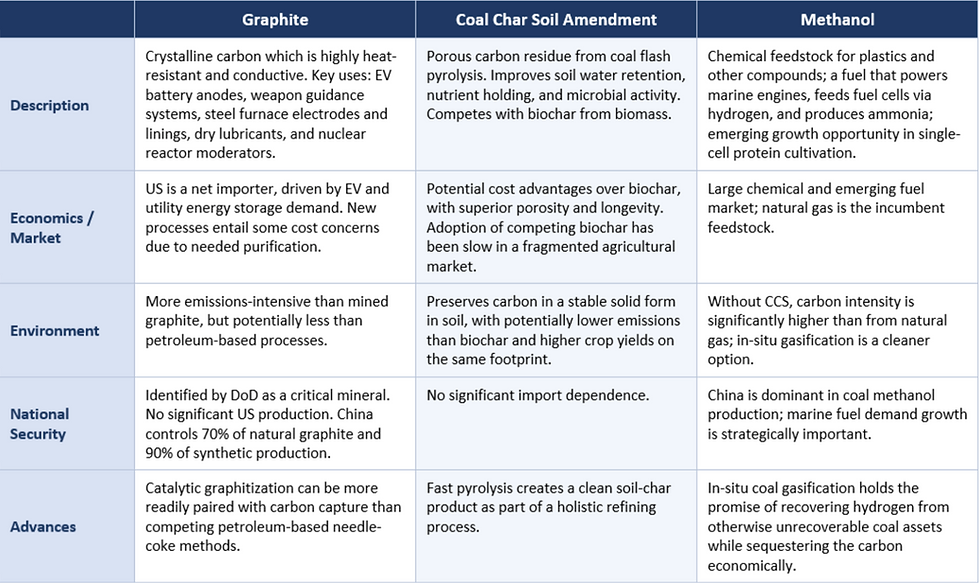
To illustrate the product assessments in more depth, Figure 2 highlights several potentially attractive coal-based materials along with some recent advances. Graphite is a high value substance that is critically important to US energy storage and missile guidance applications, for which there is very little US production. Coal char is a bulk material used to improve soil health with potentially favorable attributes relative to nascent biochar products. Our assessment includes recent environmental advances in its production, pioneered by the University of Wyoming School of Energy Resources (SER), moving its environmental score into positive territory. Lastly, liquid methanol is used in plastic production and low-carbon marine fuels, while seeing emerging use in single-cell protein cultivation used for low-impact animal feed. While traditional production methods of this liquid fuel suffer from the headwinds discussed above, extraction methods conducted underground may improve economics and limit environmental concerns.
Figure 2: Highlighted coal-based products
A summary of our assessment is shown in Figure 3, highlighting some opportunities for catalytic capital. Recently, a $40M grant by the Wyoming legislature enabled the above-mentioned advances in coal char production. The SER coal refinery demonstration plant (Figure 4) in Gillette, WY will go online this summer, producing coal char and other products in an oxygen-free environment without airborne GHG emissions. Similar environmental advances in graphite and methanol could elevate the products to be true triple threats in our analysis: positive in each of the economic, environmental, and national security lenses (denoted with an * in the chart). As we speak, Wyoming-based US Carbon is developing a less environmentally taxing method of graphite production method when compared to existing synthetic petroleum coke processes. Meanwhile, Canadian firm C’Victus is pioneering in-situ coal gasification where hydrogen-rich gas might enable cheap, clean methanol production. Funding in each of these areas could accelerate commercialization of these environmentally friendly processes. Such advances are also conceivable in other strategically important products listed below including coal tar pitch.
Figure 3: Coal products across Economics, Environment, National Security lenses

Figure 4: University of Wyoming School of Energy Resources coal refinery plant

Summing up, coal products have long been developed and used to meet national security imperatives. Current de-globalization trends and environmental issues dictate that the US should consider the beneficial uses of its massive coal stocks beyond simple combustion. Breaking with the past, there are opportunities for investment in new coal-based processes which have the potential to simultaneously create economic and environmental benefits. This is an area where capital from the private, philanthropic and government sectors could provide a meaningful fulcrum.
Other thoughts stemming from this work include the following. Rare earth element extraction from coal is receiving increased funding and interest from investors. This approach has the potential to perform relatively well in all three lenses of investigation, particularly as it is concentrated in existing coal ash waste. Rare earth element extraction will be the subject of a future piece. Secondly, a fresh look at coal refining may enhance the economic viability of coal products, allowing for lower environmental impact on an absolute basis and compared with existing processes. Humankind has, for the most part, moved beyond the straight burning of crude oil because the parts are more valuable than the whole. It may be instructive in the future to think of coal rather as “crude coal”. In such future efforts, the Jackson Hole Institute would like to see environmental considerations placed at the same level as market economics and national security. Lastly, with petroleum and natural gas representing key feedstocks for many of the products we surveyed, it may be wise for the US to weigh preservation of these resources for future generations of innovators to utilize, while considering which coal products are more efficiently produced.


Comments