


Rare Earths: China's Chokepoint and Wyoming's Opening
Introduction
Trade disagreements between the US and China have increasingly brought rare earth elements (REEs) into global focus. China has spent decades developing chemical processes and machinery to separate raw ore and clay into the pure elements used in technologies like wind turbines, EV motors, and missile guidance systems with strong demand growth expected to continue. This deep dive by the Jackson Hole Institute explains the world’s reliance on China rare earth processing, Western attempts to reshore the supply chain, and how Wyoming is playing a substantial role. We discuss technological advancements and environmental impacts which could shape outcomes in this high-stakes sector.
Background
From the mid 1960s to the mid 1980s, the US was the dominant producer of REEs from the Mountain Pass facility in California. A variety of studies (for example 1, 2, 3) attribute the industry’s downfall to declining usage in oil refining, radioactive wastewater pipeline spills, and a lack of focus on what amounted to a small market. Meanwhile, China’s production grew as a byproduct of massive iron ore mining operations. Costs were lowered through cheaper labor and lax environmental controls. Importantly, China viewed rare earths as a strategic imperative; in 1992 Deng Xiaoping reportedly remarked: “The Middle East has oil. China has rare earths.” The country grew its rare earths industry systematically through export quotas and consolidation into state champions. In time, the investment paid off as new technologies have come to depend on the country’s expertise.
Rare earth elements are a subset of the critical minerals designated by USGS and the critical materials detailed by DOE. Notably, DOE’s energy-specific list names only the four rare earths used in permanent magnets. Taking a step back, REEs consist of lanthanum through lutetium on the periodic table, as well as yttrium and scandium due to their similar chemical properties. Rare earths are not actually all that rare; in fact, cerium is more abundant than copper. However, REEs are seldom concentrated in economically viable deposits and are almost never found in pure form. Instead, they occur together in raw form due to their similar size and electrical charge. Rare earths are categorized as either light or heavy with the former more abundant. Light REEs are commonly found in the hard rock ores bastnaesite and monazite, including in the US. These minerals require energy intensive mining, crushing, and high temperature acid roasting. In contrast, heavy rare earths tend to be found in ionic adsorption clay, mostly in tropical zones outside the US. Most are currently produced in Myanmar or across the border in southern China. They are easier to mine through ammonium sulfate leaching; however, the practice often involves severe water pollution, heavy metal contamination, and landslides. Figure 1 shows more detail on the spectrum of REEs.
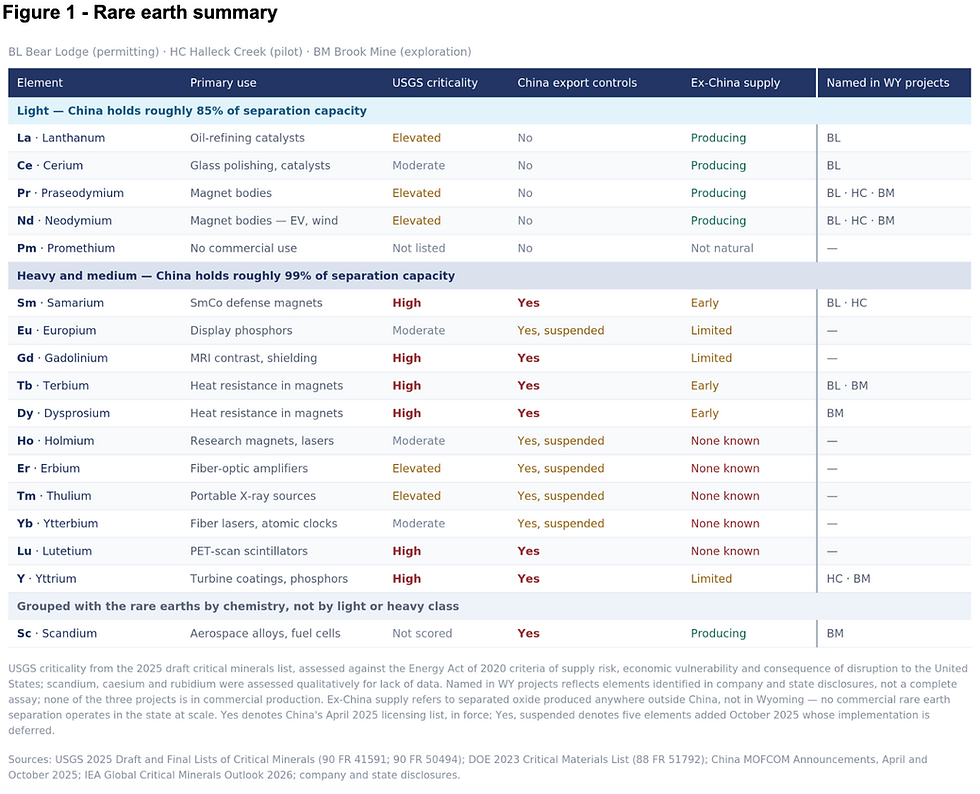
Separation, the next step, is the reason China dominates the rare earth trade. The process is complicated by the similarity of the elements involved. Heavy REEs are the most similar and thus the most difficult to separate. This requires hundreds of stages of solvent extraction using particular molecules to bind precisely-sized rare earths. China is the worldwide leader in this technology, accounting for over 80% of light REE and nearly 100% of heavy REE separating capacity. After separation, the resulting oxides are reduced to metal, alloyed, and milled to powder. The largest use of these powders is for permanent magnets where China again dominates production, registering upwards of 94% of capacity with Japan a distant second. Each of these production steps requires industrial capacity like furnaces and electrolysis cells which the West has not yet built at scale, instead relying on China processing. This adds a second chokepoint to Western adoption through the time and execution risk involved in the needed industrial build-out.
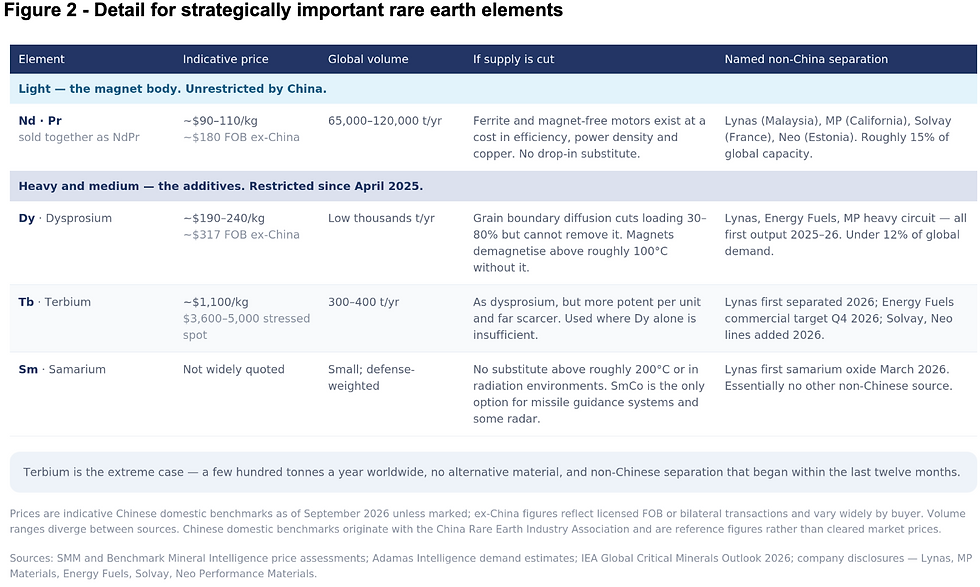
Permanent magnets are largely manufactured using neodymium and praseodymium (light) for the bodies, sometimes in combined NdPr form. Dysprosium and terbium (heavy) are added in smaller amounts to maintain magnetic strength under high temperatures. Permanent magnet demand is projected to grow by 7-8% per year over the next decade, stemming from electrification including EV motors, offshore wind turbines, and robotics. Other commonly used REEs include lanthanum (crude oil cracking, metal alloys), cerium (auto catalytic converters, polishing powders), yttrium (jet engine turbine blade coatings), samarium (precision guided munitions). See Figure 2 for more information.
China flexes policy muscles
China leveraged its dominant position as a trade chip in April 2025, placing onerous licensing requirements on heavy REE exports. The list included seven medium and heavy REEs, among them terbium, dysprosium, samarium, and yttrium, on which the US military complex is particularly dependent. China’s restrictions on heavy REEs have resulted in different markets for mainland, offshore licensed, and unlicensed players with the latter paying multiples higher to source very limited material. In contrast, China has thus far placed no restrictions on light REEs, which make up the core material of many magnets. These elements see greater global availability as the West develops hard rock resources and processing. Since both classes of REEs are required for critical military hardware, China appears to be exerting its leverage through heavy REE markets while pursuing a high-volume strategy in light REEs.
In October 2025, China added additional heavy REEs to its restriction list, though none are critical for magnets. More significantly, China imposed stronger restrictions to limit machinery and process intellectual property exports which it later suspended twice with the measures currently scheduled to go into effect January 10th, 2027. In July, China responded to seemingly unrelated US actions with sanctions on US supply chain auditors. The calculated action by Beijing complicates the supply chain verification process for US importers. As Chinese suppliers became wary of participating in such audits ahead of the September 24th Trump-Xi meeting, they began to refuse shipments. As a result, Chinese customs data show rare earth magnet exports to the US fell over 20% in August. This is sure to be a point of contention between the US and China in the future with the potential to further slow the West’s drive for self-reliance.
The West is building a new supply chain
Only a handful of Western companies currently contribute to the non-Chinese supply chain. Australia's Lynas is the largest ex-China producer, mining at Mt Weld and separating in Malaysia where the company entered full commercial production in 2013. Lynas supplies roughly 90% of the NdPr (light) for Japan’s magnet making industry. However, it achieved its first separated dysprosium and terbium only in 2026. MP Materials operates Mountain Pass in California, the sole US rare earth mine, separating light REEs on site and building magnet capacity in Texas. Energy Fuels processes monazite at its White Mesa mill in Utah, one of the few US facilities licensed to handle the radioactive thorium and uranium that accompany the ore. In Europe, Solvay restarted rare earth separation at La Rochelle, France, and Neo Performance Materials runs a separation plant in Estonia and makes magnets in Narva. USA Rare Earth commissioned its first commercial magnet production line in Oklahoma this year and this month broke ground on a larger facility in South Carolina which will in-house the intermediate steps between separated oxides and magnet production, with permanent magnet production expected in 2028. The company also acquired Serra Verde in Brazil, the most prominent heavy REE asset outside Asia. Notably, Western separators have added heavy REE capability in the past two years, though collectively they produce only a single-digit share of global heavy supply.
Exploration and development are accelerating, though few new projects are nearing production. The large Tanbreez project in southern Greenland owned by Critical Metals Corp. is likely a post-2030 story as it has advanced only to preliminary economic assessment while large scale port and infrastructure work are also needed. Its unique eudialyte ore is rich in heavy REEs and low in radioactive elements; however, it is difficult to process with no commercial separator plants operating anywhere in the world. Elsewhere, Australia's Arafura took a final investment decision on its Nolans light REE project in 2026, and additional ionic clay deposits are advancing in Brazil and Chile, including projects by Meteoric, Viridis, and Aclara, though none are currently producing as Serra Verde is. In the US, developers are testing unconventional feedstocks including coal ash and recycled magnets.
Original IRA legislation included a 10% production tax credit for REE processing; following OBBB legislation in 2025, a phase-out period was introduced which ends in 2033. More recently, Washington has responded to China policy by taking direct equity stakes and extending loans, though it has set a price floor for only one company rather than the industry. The Department of Commerce finalized agreements in June 2026, giving USA Rare Earth access to up to $1.6 billion through the CHIPS Program, in exchange for shares and warrants leaving the government with an 8% to 16% stake. The Department of Defense invested $400 million in MP Materials in July 2025, becoming its largest shareholder, and set a ten-year price floor for NdPr alongside a commitment to purchase the full output of a new magnet facility. The Office of Strategic Capital extended a $620 million loan to magnet maker Vulcan Elements and $150 million to Niron Magnetics, which is developing rare-earth-free iron nitride magnets. Project Vault, announced in February 2026, established a $12 billion strategic critical minerals reserve. On the demand side, Defense Department acquisition rules will prohibit Chinese magnets in weapons systems beginning January 2027, requiring contractors to trace magnet content to the mine. The structure reflects a specific lesson: in the mid-2010s, after a WTO ruling forced China to lift export quotas, prices collapsed and bankrupted Molycorp, then owner of Mountain Pass. Price floors are increasingly seen as a necessary ingredient in the Western supply chain to protect fledgling producers.
The West faces substantial supply chain obstacles. Separation chemistry takes years to master, and the expertise is concentrated among Chinese and Japanese operators. Permitting adds three to five years beyond Chinese timelines. Monazite ore carries thorium and uranium, triggering radioactive materials licensing requirements. Construction has run over budget and behind schedule even in favorable conditions: Australia's Iluka, building a refinery on a brownfield site with existing feedstock and a A$1.65 billion government loan, slipped two years and exceeded its capital estimate by more than half.
The environmental toll of REE production has been substantial. For instance, Chinese processing has created a tailings impoundment near Baotou holding roughly 200 million tons of thorium-bearing waste above the Yellow River. Meanwhile, ionic clay leaching in Myanmar has contaminated rivers flowing into Thailand with arsenic. These unfortunate actions lower costs, something that should not be repeated by the West. Indeed, the Serra Verde ionic clay project for heavy rare earths will use more costly contained leaching to process its ore, rather than injecting ammonium sulfate directly into the hillsides as is the practice in Myanmar.
In sum, the IEA sees China's share of rare earth refining falling from 91% in 2024 to 85% in 2025 and roughly 70% by 2035. This progress is likely led by light REEs with their heavy counterparts starting from a much lower base. The IEA also finds that as the world refines more of its REE production, the bottleneck may shift to magnet manufacturing. Announced Western magnet capacity would cover only a third of expected non-Chinese mined supply by 2035, compared with two-thirds for refining.
Wyoming has large REE deposits and has supported multiple projects
Wyoming’s $105 million Energy Dominance Fund was ratified in July 2026 and is built to make matching grants and loans to energy activities including rare earth and critical mineral processing. The separate $16 million Wyoming Rare Earths Fund was established earlier this year and is also managed by the Wyoming Energy Authority. A predecessor program, the Energy Matching Fund, previously awarded grants to several REE projects discussed here (Figure 3).
Wyoming holds a number of North America's significant rare earth deposits, each with a different geology. Bear Lodge, near Sundance in the northeast, is a bastnaesite deposit developed by Rare Element Resources, with a demonstration separation plant in nearby Upton where operations are currently ramping up. The deposit is rich in neodymium and praseodymium and also carries samarium and terbium. The project received expedited FAST-41 federal-permitting coverage in March 2026 but still requires NEPA with environmental review expected to conclude in 2028. Actual production would likely be well later. The project was awarded $4.4M in Energy Matching Funds from WEA in June 2023 and has secured a non-binding $553 million EXIM letter of interest.
Halleck Creek in Albany County, developed by American Rare Earths, is reported as the largest known US rare earth deposit by volume. It is unusual in hosting rare earths in allanite rather than bastnaesite or monazite. Named elements are neodymium, praseodymium, samarium, and yttrium; all have defense applications. The project is almost entirely on state land, which materially shortens permitting timelines. The company is running a staged pilot program using Western Research Institute in Laramie for milling and DISA Technologies in Casper for physical separation and concentration, though chemical separation for the pilot will take place at Saskatchewan Research Council. American Rare Earths received Energy Matching Funds from WEA of $7.1M as well as a non-binding $456 million EXIM letter of interest. The company intends to build processing on site for the production phase. Production is expected in 2031 with capital attraction named as a primary challenge.

Wyoming coal a massive but dilute source of REEs
The University of Wyoming's School of Energy Resources published a novel study in 2026 concluding that active coal mines could also be utilized for critical minerals. Researchers note that the highest amounts of REEs are found at the edges of the coal seam and waste piles which could enhance recovery. The school operates a pilot facility at the Wyoming Innovation Center near Gillette testing the National Energy Technology Laboratory's Targeted Rare Earth Extraction process on fly ash. It is also building a coal refinery demonstration plant with solvent extraction construction planned for late 2026.
Ramaco's Brook Mine outside Sheridan targets rare earths in coal rather than in conventional ore, a major potential opportunity for the largest coal-producing state in the US. Coal deposits contain very small concentrations of REEs though the mix is skewed towards heavies. Ramaco has received $6.1M in Energy Matching Funds from WEA to build a separation facility onsite. However, initial production will be sent to Saskatchewan Research Council by downstream partner REalloys, which has also received a non-binding $200M EXIM letter of interest. Ramaco's project is still classified as exploration-phase with first production not expected before 2028 or 2029.
Peabody Energy plans a pilot facility at its Rawhide mine north of Gillette to produce mixed rare earth concentrate from Powder River Basin coal. The company reports heavy rare earths at 21-28% of total rare earth content, along with other critical minerals like gallium and germanium in some cases. The project received $6.25 million in Energy Matching Funds in February 2026 and a share of a $75 million Department of Energy award in July, though its portion was not disclosed. Peabody describes the initiative as early stage.
Conclusions
China is the dominant refiner of rare earth elements while demand is growing rapidly and nations are actively looking to increase supply chain sovereignty. The West has made some strides in the arena of light REE extraction and processing but has barely started its journey on heavy rare earths. This creates a great deal of leverage for China in trade negotiations and other global affairs. As the US and its allies take action to remove this constraint on tech and military sectors, Wyoming has a lot to offer including large deposits and expertise in extractive industries. Like with other minerals, an important goal should be to build as much of the value-added processing in Wyoming as possible. Further recommendations include prioritization in funding separation and processing activities rather than solely in mining. This is particularly the case for heavy rare earths as this could lessen China’s strategic grip on the segment. This focus should also extend to magnet production where China also dominates. Meanwhile, grants and funding sources should be extended to match project timelines that typically run five years or more. This would aid developers in attracting private capital, which has been identified as a major obstacle. Finally, the state should build on the University of Wyoming's genuine national advantage in coal-derived critical minerals by funding the workforce and applied research pipeline directly, because separation expertise is the scarcest input in the Western supply chain.


Comments